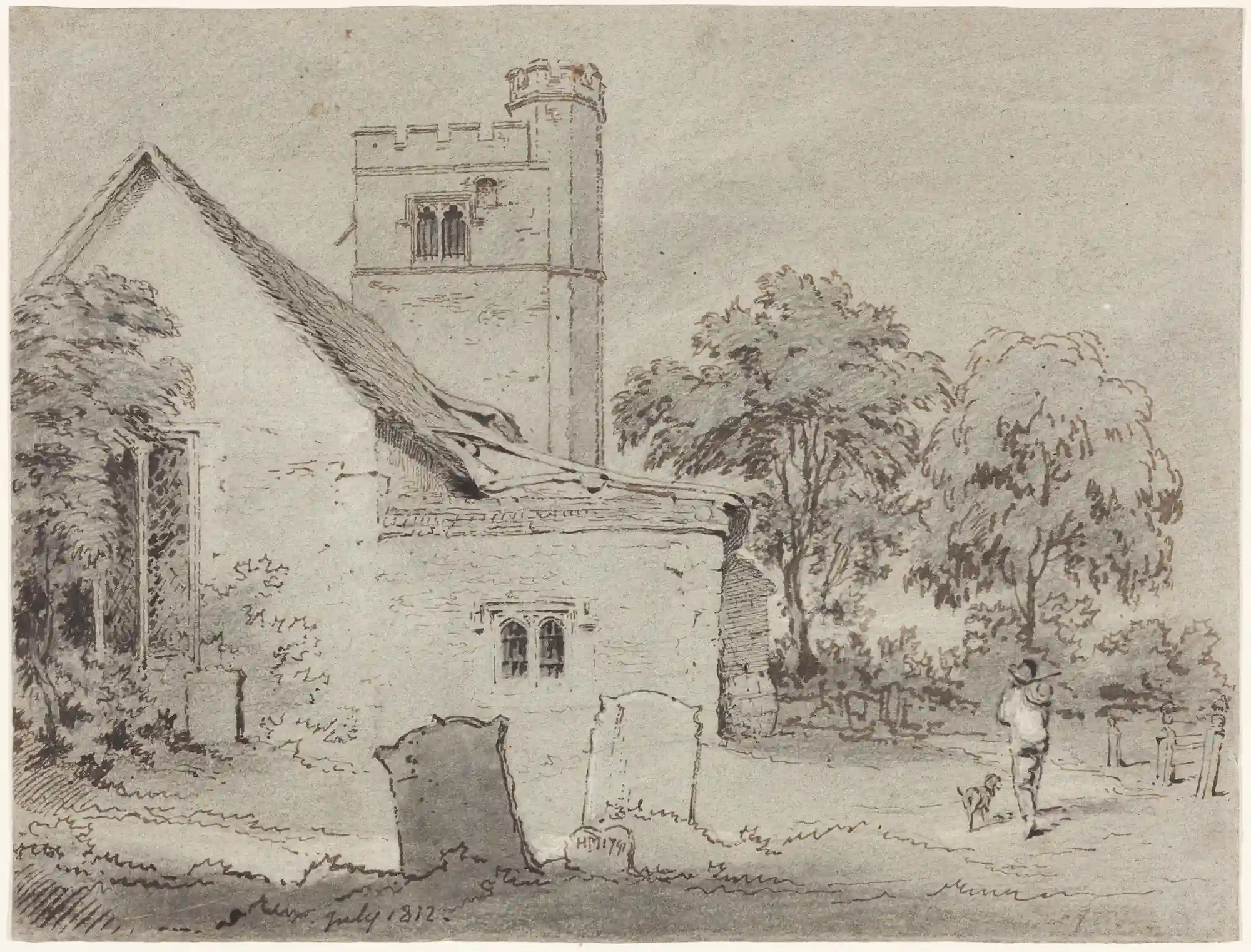
Aldenham Church, Hertfordshire, by Henry Monro

The Grief Lexicon

Dear Mama,

I opened your bag today. The orange one Mrs. A gave you on your last birthday, the one with the gold buckle you said made you “feel like a senator’s wife.” I don’t know why I was reaching for it. Maybe I was looking for something I didn’t know I’d lost.

Inside, I found the clothes I had prepared to send down to the hospital, the evening before you left me, left us.

I picked up your wrapper, still folded, still smelling faintly of Dettol and your skin. I didn’t cry. I didn’t even feel sad.

I just felt… something. Something sharp, but quiet.

Something unnamed.

Maybe it’s one of those feelings that still belongs in the Grief Lexicon: a growing collection of words I’ve learned and used because you left.

So, here’s a list. A few entries from the vocabulary of the bereaved. Words I now carry like breath in my chest:

  1. Ghostwear (noun, invented):

Clothing once alive with someone’s presence.

It no longer fits the body, only memory.

When I saw your wrapper, I wanted to press it to my cheek. Instead, I just folded it back, like I was tucking you in again.

  1. Saudade (noun):

A deep emotional state of melancholic longing for someone absent. A love that remains even after the person does not.

I feel it in the pause after I say your name to no one. I feel it after I play your favorite songs. Saudade is not just missing you, it is the ache that follows remembering how it felt to be whole in your presence.

There is no true English equivalent that feels right — your absence has always been difficult to translate.

  1. Almost (adverb):

Used to describe what nearly happened; what was on the edge of becoming real.

I almost called dad last week to wish him a happy wedding anniversary , but I didn’t because I guess you’re not married anymore and I wouldn’t want to reopen wounds.

I almost listened to them when they advised me to delete your phone number (but I didn’t ).

I almost lost the call recording I mistakenly made a few years ago; a recording I now listen to daily to remind me of your voice.

  1. Grammar of Absence (phrase):

The rules of language that falter when someone dies.

Examples:

“She was— is— was my mother.”

“She would’ve loved this movie.”

“We used to—” (pause).

Loss breaks language. Tenses become unreliable. I toggle between past and present like someone trying to find their footing in an earthquake. Do I honor you by keeping you alive in verbs? Or by letting you go in silence?

No one teaches you how to conjugate a relationship that has ended but never left.

  1. Unsaid (noun):

The words we do not say. The words we do not know how to say.

Example: “You have to be strong, you’re the mother of the house now.”

Instead of: “This must be unbearable, I’m here for you.”

Instead of: “I don’t know what to do with your pain.”

“She’s resting in heaven now.”

Instead of: “I really do not know where the soul goes after death, but I hope she’s in a good place.”

Instead of: “I don’t even know if souls continue to exist after death.”

There are entire languages made from what people mean but don’t say. I speak Unsaid fluently now. It sounds like the applause I pretend to hear after singing to an empty house. It sounds like breathing through tears, with pain no one else understands. It sounds like saying, “I’m fine” when my chest feels tight.

  1. Akhié (noun, Edo):

A word that means grief in our local dialect. More specifically, I heard the adults say “Ó rrha khié”, which means “he is grieving”, whenever brother would go outside and just stare at your grave for long moments.

  1. Never (adverb):

A word that best describes all the memories we’ve been deprived of creating.

You never get to see me graduate.

You never get to see your daughters become beautiful, independent women.

You never get to go ‘wedding-dress shopping’ with me. We never get to gossip about the lucky man.

I NEVER get to have you back! (Can you tell I’ve been crying as I write this?)

  1. Talundor (noun, invented):

A word I made up to describe how I feel when I see my peers with their moms. It’s not exactly ‘Jealousy’ (maybe a cousin though). It’s accompanied by tears, nostalgia, and a sense of loss.

I feel it every Mother’s day. I felt it when my best friend made a video of her and her mother.

  1. Proleptic Permanence (coined):

The feeling of living as if someone’s presence is a given, even when you know (or should know) that nothing is guaranteed.

I lived in a state of proleptic permanence, never imagining a version of life that didn’t have you in it.

I assumed you’d always be there, assumed we’d get to have our mother-daughters trip to Greece. I assumed you’d be there to console me during my first heartbreak. But here’s another word that fits: WRONG!

  1. Wrong (adjective):

The state of being mistaken or incorrect.

I was wrong about all of it, just like I’m probably wrong about dad seeing someone new (I really want to be wrong about this, mom).

  1. Lifetime (noun):

The duration of time I will grieve you. Not a year or two, like they said. Sure, it gets easier on some days but on others, I ache—very much—as if it happened yesterday.

  1. Hope (verb):

The word I hold in my mouth when I say, “I’ll see you again someday.”

I hope we meet in Eternity.

I hope the family becomes complete again.

I hope to fill you up on everything that happened while you were gone.

But it probably will not happen, right? That’s not how Eternity works… is it?


That’s all for today, mama.

I just wanted to tell you that the wrapper is safe. Your bag is still up on the shelf.

And me? I’m still learning—how to simply be, without you here to guide me. Still adding words. Still becoming, even in your shadow. Still yours, always.

I miss you.

With love,
Your daughter.

September 30, 2025


Further considerations
[fiction]

Baby Boom and Bust

By Thomas Wright

‘Howdy hoody! Lemme guess: you was just passing through the middle of middle England, and you recognized the flame-decorated Ferrari outside my Hobbit Hole, and you buzzed ‘cos you fancied a parley?'

[article]

Telling the Truth

By Randi Schalet

I once told a therapist my father was molesting me. It wasn’t true. I was twenty-five and exhausted, lying awake most nights trying to understand why I felt so sad when nothing in my life was obviously wrong.

[poetry]

Thoughts of Endangered Paper

By Kenneth Nichols

Here I am, looking at this copy of a // two hundred-dollar book.

[poetry]

this is about capitalism, and The Poet Sees Her Ex at Pride

By Emma Johnson-Rivard

duty pulled a mountain along lesser used roads. // time was ill-spent preparing workers for the crossing.