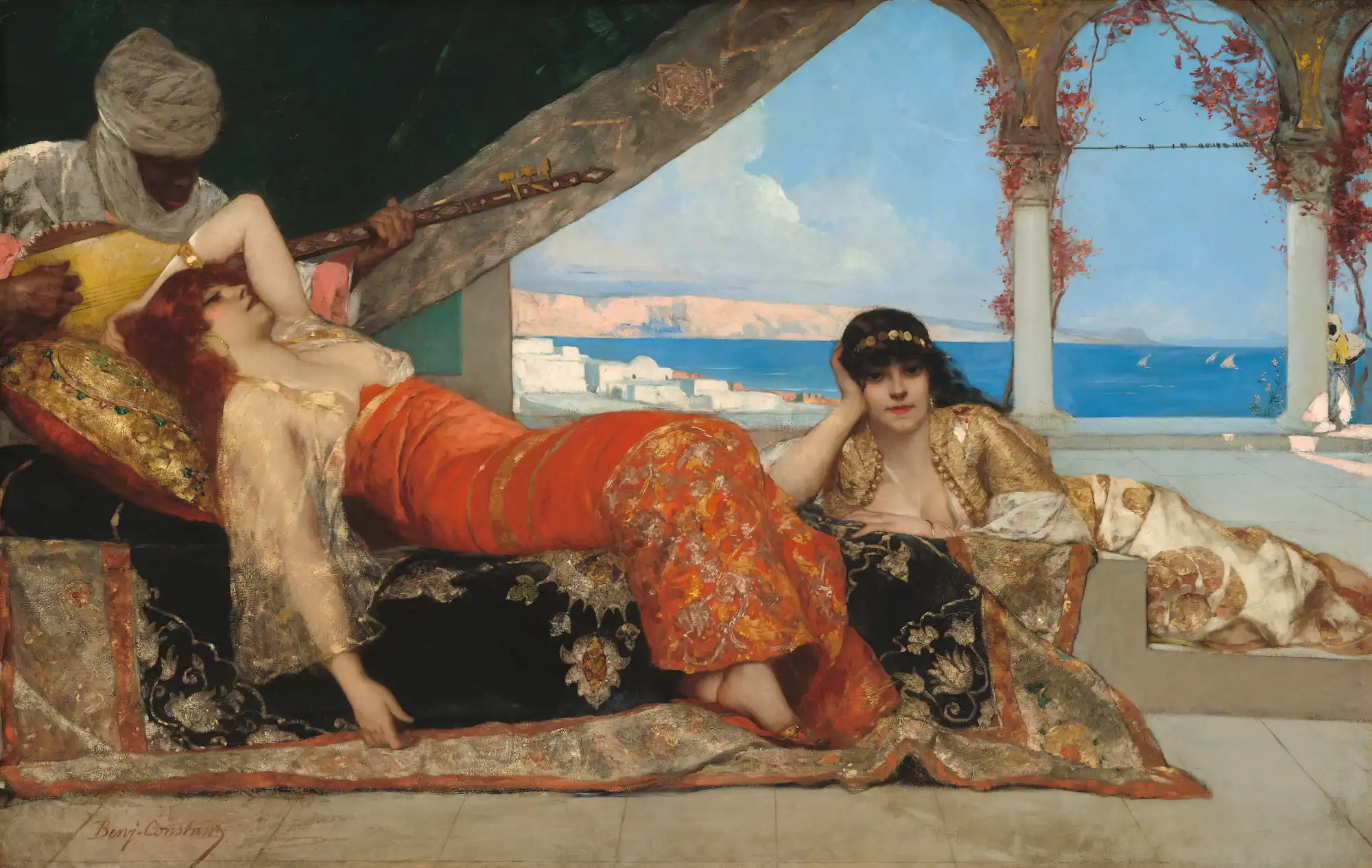
The Favorite of the Emir, by Jean Joseph Benjamin Constant

Telling the Truth

I once told a therapist my father was molesting me. It wasn’t true. I was twenty-five and exhausted, lying awake most nights trying to understand why I felt so sad when nothing in my life was obviously wrong. I counseled clients at my internship and talked too much in my graduate classes, hearing myself go on. Even dinners with friends felt off, like I was performing a version of myself they expected.

Dr. D was calm and steady. We met in her home office on a neat, tree-lined street. At first her focus seemed absolute. She had a way of holding still that made me want to tell her everything—how unsure I felt, how much I wanted someone to help me make sense of myself. I’d start talking and forget where I was going, watching her face. When she suggested we meet twice a week, I agreed, though I could barely afford my rent.

My father and I were already not speaking. The cutoff had started months earlier, after one of his rants about my mother—saying she’d stolen his money and ruined his life. I hung up mid-call and stopped returning his messages. I was tired of being in the middle. The rift between us made it easier to lie.

I described to Dr. D how unhinged my father had become after the divorce, how even ten years later he couldn’t let it go. On Sundays he’d pick us up—the visits my mother insisted on and we dreaded—and he’d call her a whore, yelling that she’d betrayed him and taken everything he’d worked for. He said he’d hire someone to kill her. No one took his threats seriously—still, her lawyer suggested she get a restraining order. I couldn’t tell which loss angered him more—being left or being robbed. Either one could set him off.

Dr. D nodded, her expression unreadable. Lately, she seemed distracted; she’d pick at a loose thread on her chair, as if she were waiting for the real story to start.


One afternoon, desperate to pull her back—something slipped out, something I never meant to say—that my father used to come into my room at night.

Dr. D leaned forward, eyes wide. “That sounds terrifying,” she said. A small rush of relief went through me. She was with me.

My eyes drifted to a copy of Frog & Toad Are Friends on her bookshelf. I mentioned that I’d loved those stories as a kid. Dr. D smiled. “That book must mean something to you.”

She explained that to survive the abuse, parts of me had split off into different personalities, ‘alters,’ she called them—each one holding what the ‘core self’ couldn’t bear. There was the little girl who experienced the abuse, the one who carried the helplessness, another who carried the anger. Each alter, she said, had its own age, voice, and identity. “It’s how you survived,” she told me. “Those parts took on what you couldn’t, so you could keep living your life.”

It sounded like she thought it was a good thing.

That night I opened a new spiral notebook and wrote Alters at the top. I added one name—Diana, after my favorite cousin. Then I made a column labeled ‘description’ and wrote—five years old, clingy. Three-legged beagle; leash looped over the bedframe.

Dr. D would ask, “Who’s here today?” and I’d supply a new name, a personality to match, until there were six of them. It felt creative—almost thrilling—to watch it take shape.

Sometimes Diana, sitting cross-legged on Dr. D’s rug with Frog & Toad on her lap, would rub her head against Dr. D’s leg.

My professors called multiple personalities a fad. But Dr. D seemed certain, and I didn’t correct her. It was the story I’d committed to and by then, I was too far in to take it back.


There was Marcy, the impulsive twenty-year-old alter who had one hookup after another—the latest with a tired looking taxi driver who barely said a word on a pile of jackets in his backseat. Dr. D leaned forward, suddenly earnest—lecturing about condoms and spermicide, how Marcy needed to use both—then asking her to check in at the start of each session.

David, the only boy in the system, tried to be our protector, but the others just laughed. When I “switched” to David, I took up more space, uncrossed my legs, stretched my arm along the back of the chair, and lowered my voice.

Like Sybil, which I studied as an instruction manual, I went into fugue states. I had memory gaps. Once I pretended to wake up on a downtown Boston street, with no idea why I was there or where I’d parked my yellow Subaru. I called Dr. D in a panic, my hands actually shaking.

She answered on the first ring. “Let me talk to David,” she said. Then, calm as ever, she told me: “You took the T. Your car’s in your driveway.”

Each personality had her own postures and gestures. I practiced six different voices and taught myself to sign my name six different ways, from block printing to a fancy old-fashioned script copied from my grandfather. That handwriting belonged to Claudia, the alter who dressed like an Orthodox wife and spoke in a stern whisper.

I was surprised by how far I took it—scratching my arm with a needle, telling Dr. D I was cutting myself, showing up in long sleeves in the summer. She had us sign a typed contract: I agree not to hurt Randi.

Every alter signed it, one below the other—except perpetually pissed-off Taylor. “I’m not putting my name on that stupid piece of paper,” she declared, chewing her nails. “No fucking way.”

None of these personalities existed outside of Dr. D’s office. They were stories I invented to keep the lie alive, plots I kept turning over in my head at night. I started seeing Dr. D three times a week, taking cash advances from my credit cards to pay the bill. I was grateful; my depression had lifted. It felt good not to have to wait too long between sessions. When I walked up to her door, I was already slipping into character, remembering who I’d be that day, careful not to seem too rehearsed.

Her office was filled with objects she’d brought back from her travels. On her hand-carved wooden desk, a small amethyst clock ticked loudly, the minute hand lurching forward, the hour disappearing. Sometimes I stayed Randi, and Dr. D and I discussed the alters as if we were colleagues. The goal was to integrate six personalities, a goal that always felt impossible.

Most Saturday mornings, at Dr. D’s urging, I went to an incest survivors’ group at the Cambridge Women’s Center. I arrived early and helped pull the shabby mismatched chairs into a circle. The group was advertised as a safe space for alters to speak. But when I raised my hand, my throat went dry. I was sure everyone could tell I was a fraud.

I began to suspect that the other women were performing too—their accounts of watching children sacrificed in satanic rituals were too horrific to believe. Hearing them gave me nightmares. It was the early nineties when stories of people with dozens, even hundreds, of personalities were suddenly everywhere.

I was still inventing new details for the alters, keeping track of them in my notebook. At the same time, I was finishing my doctoral program and training to be a psychologist, just like Dr. D. In the evenings, I hung out with my feminist bi friends, where it seemed everyone had lived through something terrible. Sometimes the easiest childhoods were made to sound difficult.


We made occasional progress: Taylor managing her anger, Marcy becoming more cautious, David letting down his guard—hiding his face in his hands to sob. These were breakthroughs. But after one alter was integrated, another one soon appeared, as if neither of us were in any rush for this to end.

The new alter refused to reveal her name or age. She didn’t trust Dr. D.

“I can see what you’re doing,” she said. “You’re trying to get rid of us.”

“No one is being gotten rid of,” Dr. D said gently. “I just want to get to know you.”

“So you can destroy me too?”

“You’ll still exist,” Dr. D said, her voice calm, almost amused, like she was humoring someone who didn’t know any better. “You’ll always be part of Randi.”

“But I want to be my own self,” the alter insisted.

I was a needy patient, often contacting Dr. D between sessions. One time, distraught, playing the part— “You have to tell me, when will this end?”—I swallowed a handful of Ativan before calling her.

Dr. D phoned 911, and a cluster of uniformed men stomped single file up my narrow stairway. I opened the door, already groggy. In the ER, a tube snaked down my nose and into my stomach. The charcoal made me gag. I vomited until my throat burned.

I was admitted to the psych unit for a week. The other patients were impressed when my cool therapist—fringed suede jacket, stamped leather boots—showed up on a Saturday.

Meanwhile, my life kept moving forward—working as a post-doc at a community mental health center, fostering my difficult five-year-old daughter (whom I later adopted), and drafting my first novel, a lesbian love story.

Dr. D went on a three-week pilgrimage to Borneo. She said that multiples were seen there as mystics. She apprenticed with a shaman who, she said, had entrusted her with the cure for AIDS, though she was sworn to secrecy. “The antidote won’t be known for another five years,” she told me.

“People are dying now,” I said, stunned that she’d believe something so impossible.

“It’s not mine to share,” she said.

I wanted to argue, but I knew I wouldn’t get anywhere.

After she returned, her hallway was lined with photographs from her trip: barefoot children in embroidered skirts, craggy mountains shrouded in fog, a toothless man beside a battered snake drum, wearing a beaded collar—probably the shaman. She’d discovered she had a gift for photography.

She insisted on putting me into a trance at the start of every session. “Imagine you’re in the desert. A stone stairway appears, and you start walking down. With each step, you grow more relaxed.” I tried to visualize it, eyes closed, breathing deeply, waiting for her to finish the script.

Her voice made me drowsy, but it also made me want to laugh. I was bored with the alters—stuck in their narrow roles. I started throwing in things that didn’t line up with who they were supposed to be, as if I were daring her to question me, but she took all of it as real.

My actual life was getting more complicated, in good ways, and there were things happening day to day that I wished I could at least mention. I didn’t need the false intensity anymore.

One day, I wrote my final check, folded it into a goodbye letter, and slipped it into her mailbox beneath the shedding smoke tree. I thanked her and asked her not to contact me again. She sent me a short note and signed it “Best Wishes,” as if we barely knew each other. I thought about what I could have bought with the money I’d spent on her. I’d braced for a confrontation, but she let me go without even asking why.

It took everything not to manufacture a crisis just to hear her voice again. I hated how much I’d given her—time, money, devotion. The withdrawal was abrupt, like stopping a drug I’d taken three times a week. Getting my equilibrium back took work. For a long time, I’d talked about myself as parts that never fit together.

Without Dr. D, the story faded. The alters became a jumble, the details blurred, until it all felt like something that had happened to someone else. But the accusation stayed with me. I was glad I’d never said anything beyond the support group and her office—especially glad I’d never told my sisters.

I decided to see another therapist to try and understand what had happened with Dr. D—why I’d felt compelled to create a story which, on some level, we both must have known wasn’t true. Or maybe she didn’t know. I still wonder about that.

With my new therapist, the focus was different. She asked about my relationships—friends, my daughter—and my father, how he and I had interacted when I was young, and how my mother fit into all of it. With her, I could feel things instead of acting them out. Dr. D knew I’d adopted, but she never asked me about it.

I’m embarrassed to admit how much I craved her attention. When she worried about me or the alters, I felt a kind of warmth, a quiet rush of being at the center of her focus. All her concern was for someone I’d invented, someone who’d survived a trauma that never happened, while the one that had happened never got talked about.

After a while, I even began to miss my father. My sisters said he’d mellowed. I knew he wasn’t the man I’d described in her office.

It was another four years before I agreed to meet him at a park on a cool fall day. While my daughter and son played in the leaves, I finally confronted him.

“I was fourteen when Mom asked you for a divorce,” I said. “You made our lives miserable.”

He used to park outside our house in his white van, watching us through a haze of cigar smoke—just far enough away to satisfy the restraining order.

“How do you think that affected us?” I asked.

“She stole my money,” he sputtered.

Here we go, I thought, the same story I’d heard my whole life. Before the divorce, my mother had emptied their safe-deposit box, stuffing brown paper bags of cash from the store into an overnight case.

“It was both your money,” I said. “She knew you wouldn’t give her any.”

“Lock me in jail,” he said, red-faced. “Throw away the key. What do you want from me?”

I wanted him to apologize—for those months of fear, for working late six days a week, for never praising me, for not knowing who I was. But by then those hurts felt too small to mention.


Over the decades, my sisters and I saw him occasionally. His world kept shrinking. As he aged, we made a point of visiting every few months and calling more often, though there was never much to say.

Age softened him, and it softened me too. The resentment I’d carried for so long settled into something like pity, and behind that—to my surprise—a kind of tenderness. It was hard to connect this frail old man with the one who raged outside our house.

We both live in California now, at opposite ends of the state. We were surprised he moved to California at all, then settled so far from us.

He’s ninety-two and still steady on his feet. Last month he flew to Berkeley to visit my sister and me. I lent him my apartment and slept on my boat for the weekend. He commented on the mid-century furniture, the shag rug, the strong water pressure in my shower, trying to decide what I wanted to hear.

His bungalow is falling apart, water pouring through the roof when it rains. “If I had a crystal ball,” he said, “and I knew I’d live three more years, I’d fix it.”

My sister and I told him we’d help him move to Berkeley.

“Why?” he asked. “I’m fine. I can do everything myself.”

“Because when you’re old, it’s good to live near family. Because if anything goes wrong…” We never speak about our long estrangement.

At the airport, I hugged him good-bye, reaching to stroke his soft head. He squirmed away. “I’ll walk you to the gate,” I said.

“No, I can find it.”

“Let me buy you a newspaper.”

“I don’t need your money.”

“What will you read?” It was early; he’d have hours to wait.

“I’ll read the signs,” he said, smiling.

I watched him make his way toward security, moving slowly, carrying nothing but his boarding pass and a cracked plastic flight bag. “I love you,” I called after him, not sure he’d heard me. I knew it was true.

December 20, 2025


Further considerations
[poetry]

Thoughts of Endangered Paper

By Kenneth Nichols

Here I am, looking at this copy of a // two hundred-dollar book.

[poetry]

this is about capitalism, and The Poet Sees Her Ex at Pride

By Emma Johnson-Rivard

duty pulled a mountain along lesser used roads. // time was ill-spent preparing workers for the crossing.

[poetry]

good people on both sides, and running fingers through your hair, thin as feathers

By Kathleen Hellen

My dear trees, I no longer recognize you // The storm puts its mouth to the house